
How waste pickers can strengthen Asia and the Pacific’s cities
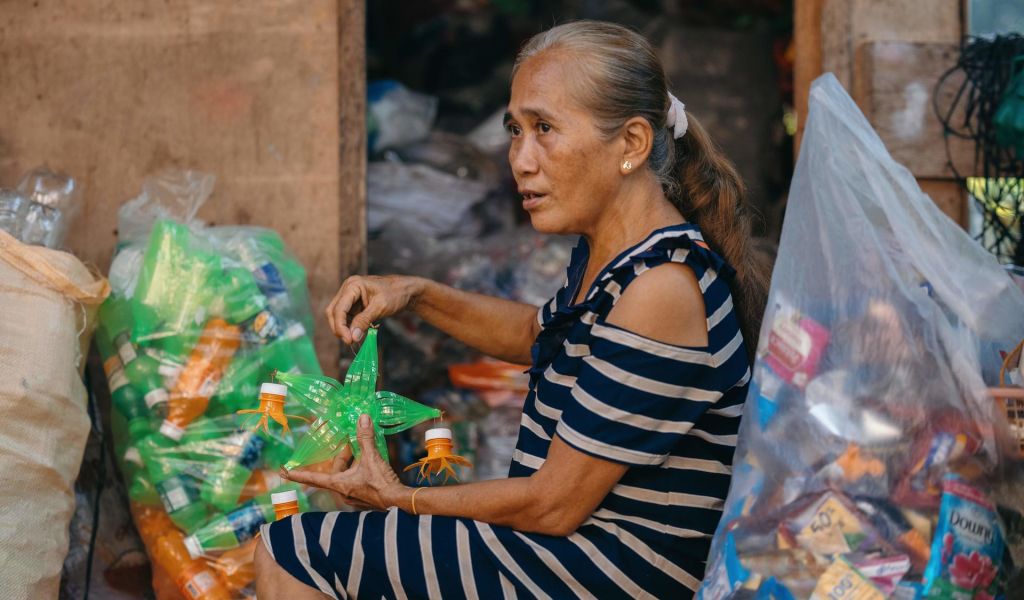
Informal workers – accounting for 65 per cent of Asia and the Pacific’s urban workforce – are central to city life, providing affordable meals, keeping sidewalks clean, laying foundations for buildings, and moving people and goods through rush hour traffic. Despite their contributions, most remain absent from urban policies and plans, operating with low and unstable incomes, minimal protections and limited upward mobility.
Some of the region’s most vulnerable urban informal workers make their living as waste pickers, playing vital but overlooked roles in urban environmental management and service delivery. The 2026 Asia-Pacific SDG Partnership Report [MM1] identifies decent and inclusive urban employment as central to building cities that are both more equitable and more resilient. With the right support and recognition, marginalized informal workers such as waste pickers can contribute to more liveable urban environments.
Essential yet excluded
In developing countries, around 20 million people — often rural-urban migrants, older persons and women — work in informal waste collection, recovering, sorting and recycling materials that would otherwise be burned or dumped in landfills and waterways. In cities with underdeveloped waste systems, they fill critical gaps.
Managing approximately 60 per cent of plastic waste collected for recycling[MM2] [CM3] , waste pickers are frontline environmental service providers, helping cities transition from “take-use-dispose” models towards more circular urban economies. Their work reduces the public health risks, environmental degradation, emissions and pollution linked to unmanaged waste. With cities under increasing strain from rapid urbanization and climate change, this can strengthen urban resilience.
Yet waste pickers remain largely excluded from formal waste management systems and earn low, unstable incomes, handling toxic materials in unsafe environments, often without protective equipment or social protection. Working outdoors, they are also highly vulnerable to worsening air pollution and extreme weather. Widespread social stigma reinforces their marginalization.
From exclusion to integration
Despite continued exclusion, new approaches are increasingly recognizing waste pickers’ contributions as partners in urban environmental management and service delivery, while improving their incomes and working conditions.
Ground-up innovations
New waste management models in communities are making a difference.In Battambang, Cambodia, “waste banks” allow residents to exchange sorted recyclables for cash or credits, creating more organized collection systems while linking waste pickers to recycling markets. The initiative also supports women with entrepreneurship training and seed funding to operate waste banks and start small businesses.
When designed inclusively, with appropriate training and technology, such models can strengthen, rather than displace existing skills and livelihoods.
Recognition matters
Recognition is a powerful tool for inclusion. In Fiji, waste pickers are formally acknowledged as “collection pillars of recycling,” helping to reduce stigma. This has been paired with practical support, including financial literacy training and healthcare access.
Similarly, in Viet Nam, public awareness campaigns, alongside improved access to protective equipment, training and social services, are helping to reposition waste pickers as environmental professionals.
Organizing for inclusion
Collective organization is key to these efforts, enabling informal workers to advocate for improved livelihoods and working conditions, while supporting inclusive pathways to formalization. In many cities, waste pickers have formed cooperatives and associations that strengthen their bargaining power, improve access to services and facilitate participation in formal waste management.
In the Philippines, the Women’s Balikatan Movement has supported the formation of cooperatives across Metro Manila, assigning waste pickers routes to collect recyclables from households and schools. Such initiatives help to stabilize incomes while reducing reliance on hazardous dump sites.
Enabling policies and partnerships
Government action is critical to scaling these efforts. In Pune, India, the Municipal Government has contracted a cooperative of waste pickers to provide door-to-door waste collection services in exchange for a small fee from households. This has improved incomes and working conditions for waste pickers, while delivering affordable services in underserved areas.
Nationally, India’s Solid Waste Management Rules mandate the inclusion of waste pickers in waste management systems, including through registration schemes. In many Indian cities, registered waste pickers receive occupational identity cards providing access to healthcare, housing support, low interest credit and education opportunities for their children.
Towards an inclusive and resilient urban future
These examples show what is possible when cities work with, rather than around, the workers who keep them functioning. Alongside creating decent employment opportunities, a more inclusive and resilient urban future requires action to create healthier and more liveable urban environments for all, and fill gaps in essential services. Efforts to support waste pickers show how these priorities can align.
The 2026 Asia-Pacific SDG Partnership Report, developed by ADB, ESCAP and UNDP, showcases initiatives that are achieving these interconnected priorities, and outlines the policy actions needed to scale them. With the right choices, the region’s growing cities can become sites of shared prosperity and resilience for the workers and communities that sustain and depend on them.